Global GST, VAT & Sales Tax Calculator: Reverse Tax Ready
Calculate GST, VAT, Sales Tax, and HST for India, Australia, UK, USA, Canada and more — with CGST/SGST/IGST split, reverse calculation, visual breakdowns and step-by-step explanations.
How to Use This GST Calculator
Select your country — India, Australia, New Zealand, Singapore, Malaysia, UK, USA, or Canada
For India: choose whether the transaction is intra-state (CGST+SGST) or inter-state (IGST)
Choose the calculation mode: Add GST (forward) or Remove GST (reverse/extract)
Enter the amount in the currency field
Select the applicable tax rate from the dropdown
Click Calculate to see the full breakdown including CGST/SGST split for India
Copy the result, share via WhatsApp, or copy a pre-filled shareable URL
GST Calculation Formulas
GST Amount
Base Amount × (GST Rate ÷ 100)
Total with GST
Base Amount + GST Amount
Base Amount (reverse)
Total ÷ (1 + GST Rate ÷ 100)
CGST / SGST (intra-state)
GST Amount ÷ 2 each
IGST (inter-state)
Base Amount × (Full Rate ÷ 100)
Late fee interest
Tax Due × 18% × (Days ÷ 365)
Global Tax Rate & Registration Threshold Comparison (2026)
| Country | Tax | Standard Rate | Currency |
|---|---|---|---|
| India | GST | 0–28% | ₹ INR |
| Australia | GST | 10% | A$ |
| New Zealand | GST | 15% | NZ$ |
| Singapore | GST | 9% | S$ |
| Malaysia | SST | 6–10% | RM |
| United Kingdom | VAT | 20% | £ GBP |
| United States | Sales Tax | 0–12% | $ USD |
| Canada | HST/GST | 5–15% | C$ |
Rates are standard/headline rates. Reduced and zero rates apply to specific goods and services.
Understanding Goods and Services Tax (GST)
GST is a unified indirect tax system that replaced multiple layers of taxation across India. It consolidates central excise duty, service tax, VAT, entry tax, and octroi into a single tax framework — making compliance simpler and reducing the cascading tax burden for businesses.
The Four Tax Components Under GST
CGST (Central GST)
Collected by the Central Government on intra-state transactions. Equal to half the total GST rate. E.g., on 18% GST intra-state: CGST = 9%.
SGST (State GST)
Collected by State Governments on intra-state transactions alongside CGST. Also equal to half the GST rate. Revenue stays with the originating state.
IGST (Integrated GST)
Applies to inter-state sales and imports. Equals the full GST rate (e.g., 18%). Collected centrally and shared between Central and destination state governments.
UTGST (Union Territory GST)
Functions like SGST but applies to Union Territories without legislatures — Chandigarh, Lakshadweep, Dadra & Nagar Haveli, etc.
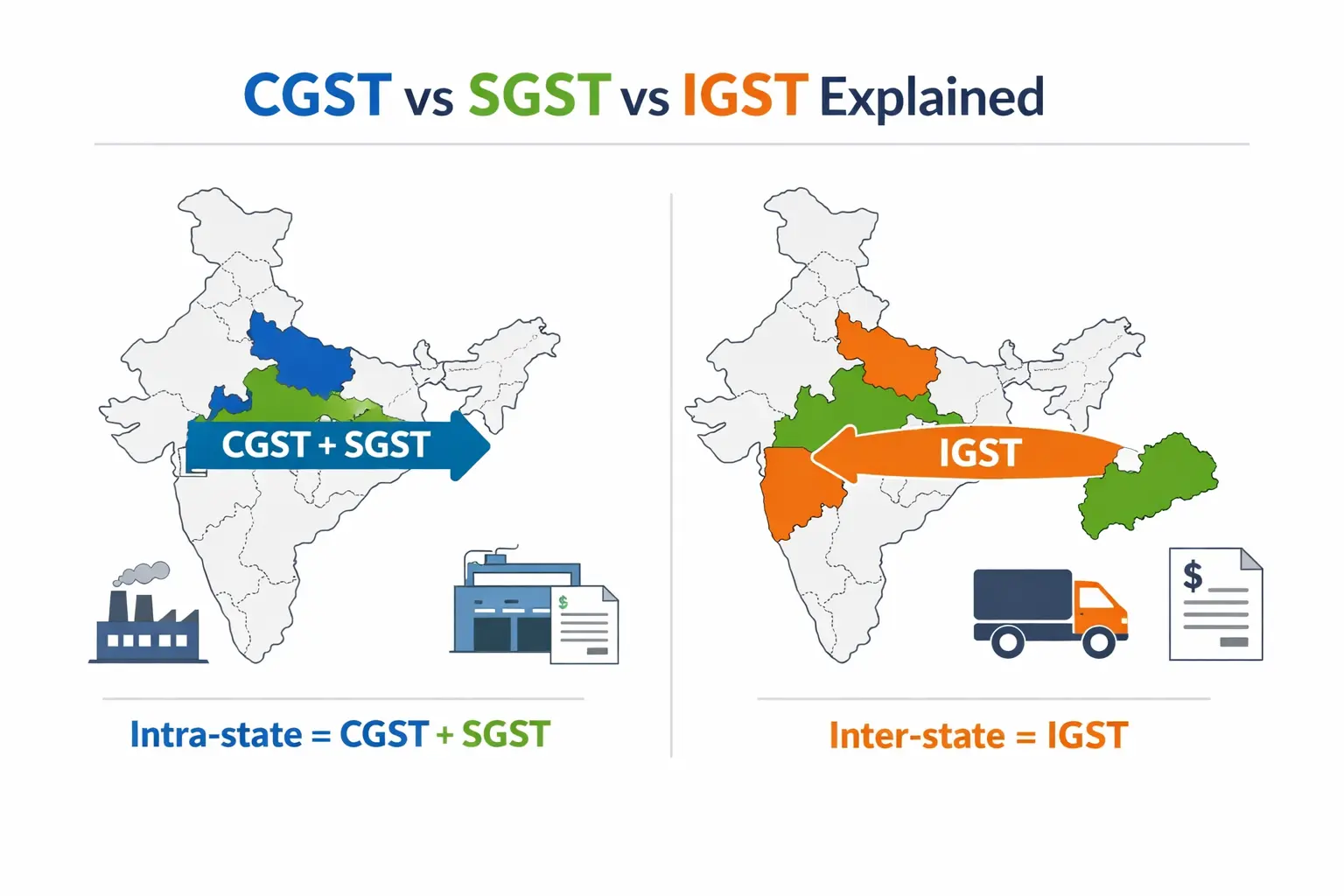
Intra-state transaction: CGST + SGST | Inter-state: IGST
Intra-State vs Inter-State GST: Which Applies to You?
The most common invoicing mistake in India is applying the wrong tax type. Here is a definitive guide to when CGST+SGST apply versus when IGST applies:
| Transaction Type | Tax Applied | Example (18% GST) | Invoice Shows |
|---|---|---|---|
| Delhi seller → Delhi buyer | CGST + SGST | 9% CGST + 9% SGST | CGST ₹900 + SGST ₹900 |
| Mumbai (MH) seller → Bangalore (KA) buyer | IGST | 18% IGST | IGST ₹1,800 |
| India seller → Export (overseas buyer) | Zero-Rated IGST | 0% (zero-rated) | IGST ₹0 (ITC refund eligible) |
| Online freelancer → Overseas client | Zero-Rated / Exempt | 0% (foreign currency received) | No GST on invoice |
Common mistake: Applying CGST+SGST on an inter-state invoice (or vice versa) is a GST compliance violation. The buyer cannot claim ITC on wrongly taxed invoices. Always verify the place of supply before issuing an invoice.
GST Rate Slabs in India (2026)
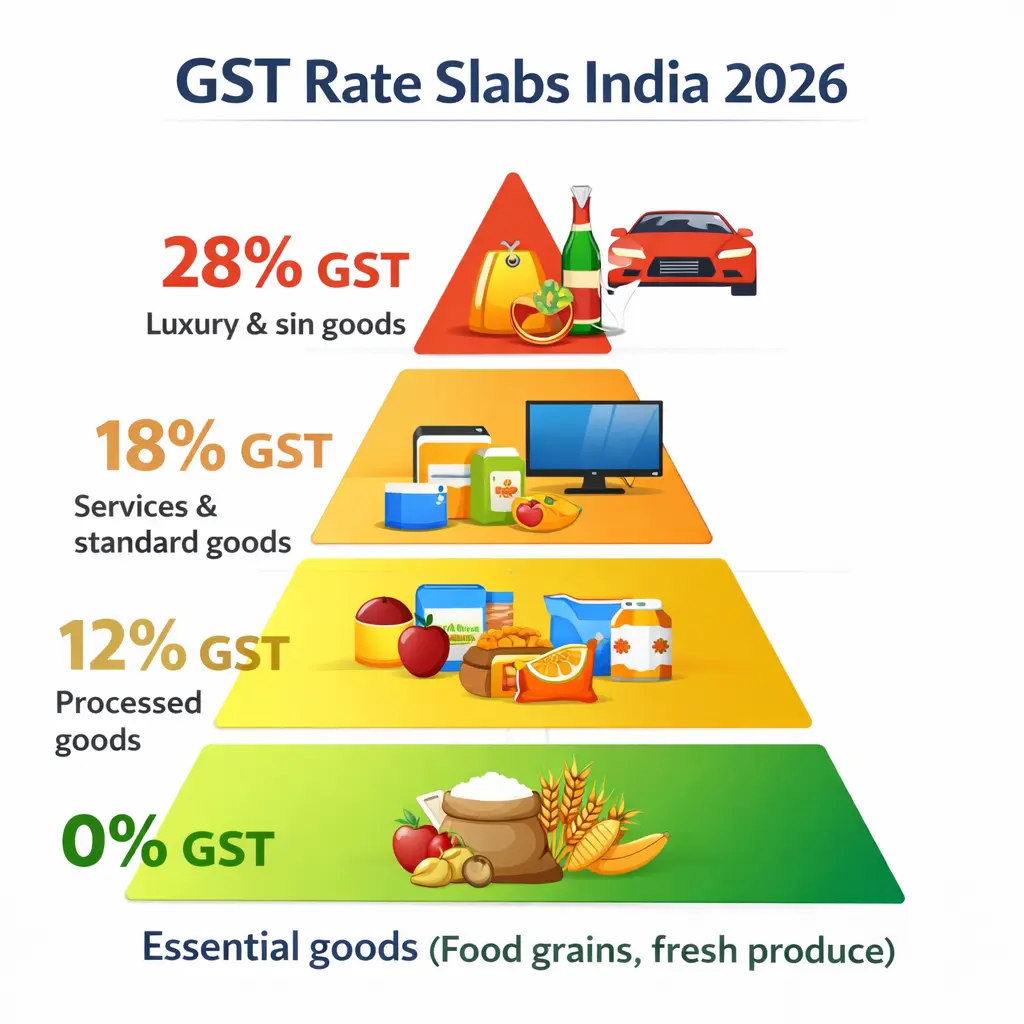
India's GST uses five primary rate slabs. Choosing the wrong rate on an invoice can result in penalties, demand notices, and ITC reversals.
0%
Essential / Exempt
Fresh vegetables, milk, bread, eggs, fresh meat, grains, salt, contraceptives, educational services, healthcare services
5%
Necessities
Sugar, tea, coffee, edible oils, domestic LPG, coal, medicines, packed food (below ₹500), economy air travel, transport
12%
Standard Goods
Computers, smartphones, processed food, butter, cheese, ghee, business class air travel, construction (affordable housing)
18%
Most Common
Electronics, IT services, financial services, AC restaurants, hotel tariff ₹2,500–₹7,500, textiles (>₹1,000), most business services
28%
Luxury / Demerit
Cars, motorcycles (>350cc), tobacco, aerated drinks, cement, air conditioners, washing machines, casino, gambling
3%
Special Items
Gold, silver, processed diamonds, platinum jewellery. Additional Cess applies on demerit goods on top of 28%.
GST by Profession: Your Industry-Specific Guide
Different professions have different GST obligations. Here is what applies to the most common business types:
Freelancers & Consultants
Rate: 18% | SAC 9983 (IT services) / SAC 9984 (consulting)
Registration
Register when annual turnover crosses ₹20 lakh (₹10 lakh for NE states)
ITC Eligibility
Can claim ITC on laptop, software subscriptions, co-working space, professional books
Filing Frequency
Quarterly GSTR-1 + monthly GSTR-3B if turnover < ₹5 crore
💡 Pro Tip
Exports of services in foreign currency are zero-rated — no GST to client, but you can claim ITC refund.
Restaurant Owners
Rate: 5% (no ITC) or 18% (with ITC) | SAC 9963
Registration
GST mandatory above ₹20 lakh. Composition possible up to ₹1.5 crore at 5%.
ITC Eligibility
Standalone restaurants: 5% rate, ITC not allowed. Hotel restaurants (room tariff > ₹7,500): 18% with ITC.
Filing Frequency
Monthly GSTR-1 + GSTR-3B for turnover > ₹5 crore
💡 Pro Tip
Zomato/Swiggy orders: same GST as dine-in. Platform does not collect GST on your behalf — you must charge it.
E-commerce Sellers
Rate: Varies by product category | HSN code per product
Registration
Mandatory registration regardless of turnover (no threshold exemption for e-commerce)
ITC Eligibility
Can claim ITC on packaging, warehouse costs, freight, business software
Filing Frequency
Monthly GSTR-1 + GSTR-3B mandatory
💡 Pro Tip
TCS (Tax Collected at Source) @1% is deducted by marketplace (Amazon, Flipkart). Net it against your tax liability in GSTR-3B.
Construction & Contractors
Rate: 18% (12% for affordable housing) | SAC 9954
Registration
Register above ₹20 lakh turnover. Mandatory for government contracts.
ITC Eligibility
ITC available on inputs (cement, steel, equipment rental) under the regular scheme.
Filing Frequency
Quarterly or monthly based on turnover
💡 Pro Tip
Composite supply of goods + services in a works contract is taxed at 18% unless for affordable housing (12%).
Medical / Healthcare
Rate: 5% on most medicines | HSN 30
Registration
Healthcare services by clinical establishments are exempt (0%).
ITC Eligibility
ITC available on medical equipment under regular scheme
Filing Frequency
Monthly or quarterly based on turnover
💡 Pro Tip
Healthcare services by clinical establishments, authorised medical practitioners are exempt from GST. Medicines at 5%.
GST Composition Scheme: Is It Right for Your Business?
The GST composition scheme is India's simplified tax option for small businesses. Instead of regular GST rates (5%–28%), eligible businesses pay a flat percentage of turnover — with much simpler quarterly filing.
Eligibility & Rates
Manufacturers of goods
Rate: 1% of turnover (0.5% CGST + 0.5% SGST)
Limit: Turnover ≤ ₹1.5 crore
Traders (goods dealers)
Rate: 1% of taxable turnover
Limit: Turnover ≤ ₹1.5 crore
Restaurant owners
Rate: 5% of turnover
Limit: Turnover ≤ ₹1.5 crore
Service providers
Rate: 6% of turnover
Limit: Turnover ≤ ₹50 lakh
Benefits
- Much lower effective tax rate on turnover
- Simplified quarterly filing (CMP-08 form)
- One annual return (GSTR-4) vs monthly/quarterly for regular dealers
- No complex ITC reconciliation required
- Reduced compliance burden for small businesses
Limitations
- Cannot claim Input Tax Credit (ITC) on purchases
- Cannot supply goods or services to another state (no inter-state sales)
- Cannot issue a tax invoice — only a bill of supply
- Buyers from you cannot claim ITC
- Not suitable if you have large input costs (ITC benefit lost)
- Not available for notified goods (tobacco, ice cream, pan masala, etc.)
Input Tax Credit (ITC): How GST Actually Saves Businesses Money
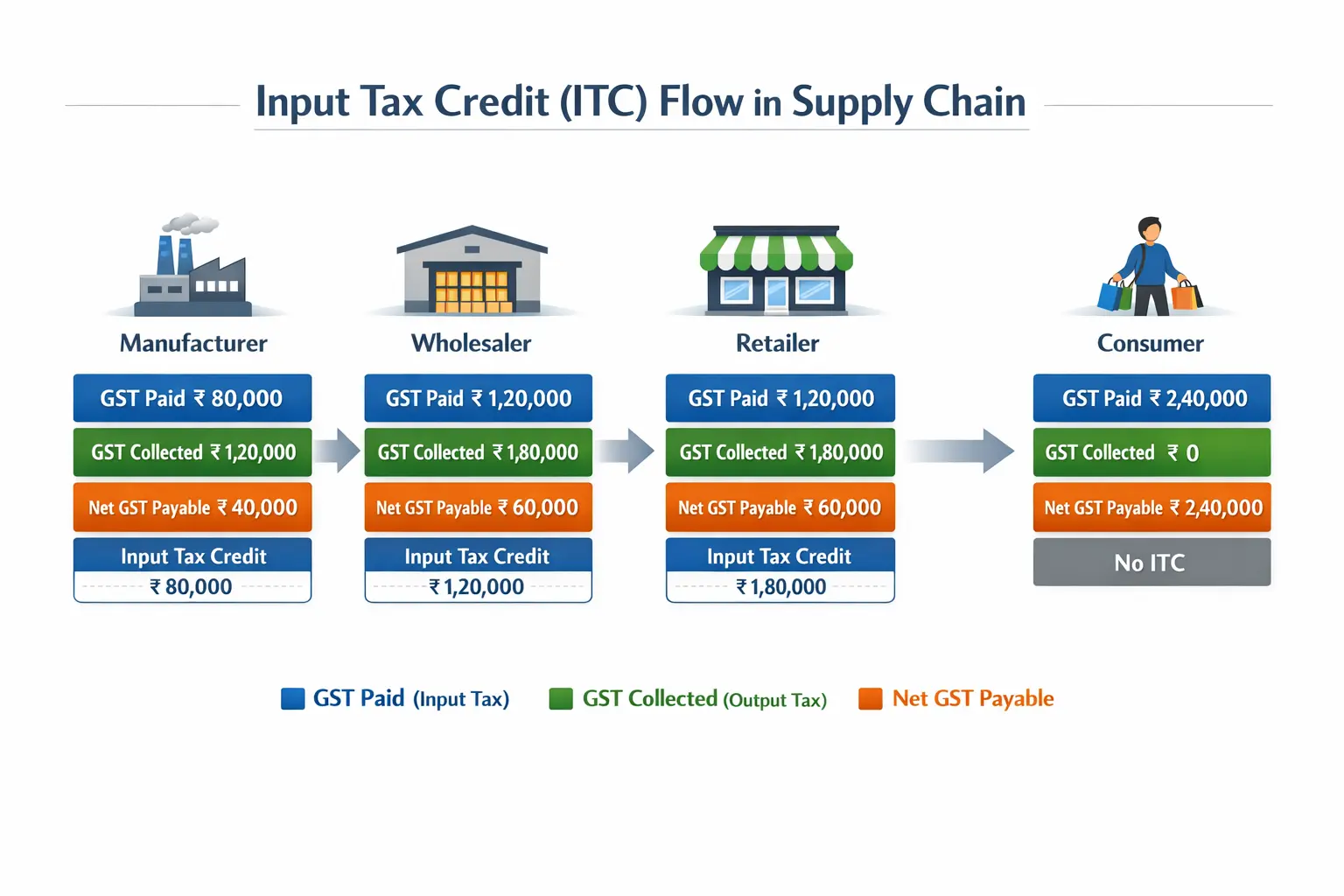
ITC is the mechanism that makes GST superior to the old VAT cascade system. It prevents the same goods from being taxed multiple times as they move through the supply chain.
| Stage | Transaction | GST Paid (Input) | GST Collected (Output) | Net GST Payable |
|---|---|---|---|---|
| Raw Material Supplier | Sells at ₹1,000 + 18% GST | — | ₹180 | ₹180 to Govt. |
| Manufacturer | Buys ₹1,000 input, sells product at ₹2,500 + 18% | ₹180 (ITC) | ₹450 | ₹450 − ₹180 = ₹270 |
| Distributor | Buys ₹2,500 product, sells at ₹3,000 + 18% | ₹450 (ITC) | ₹540 | ₹540 − ₹450 = ₹90 |
| Retailer | Buys ₹3,000, sells at ₹3,500 + 18% | ₹540 (ITC) | ₹630 | ₹630 − ₹540 = ₹90 |
| Total GST collected by Government: | ₹630 (= 18% of final sale ₹3,500) ✓ | |||
ITC Claim Conditions (must satisfy all four)
- You hold a valid tax invoice issued by a registered supplier
- The goods/services have been received
- The tax has been paid to the government by the supplier (verify in GSTR-2B)
- You have filed your GST return (GSTR-3B)
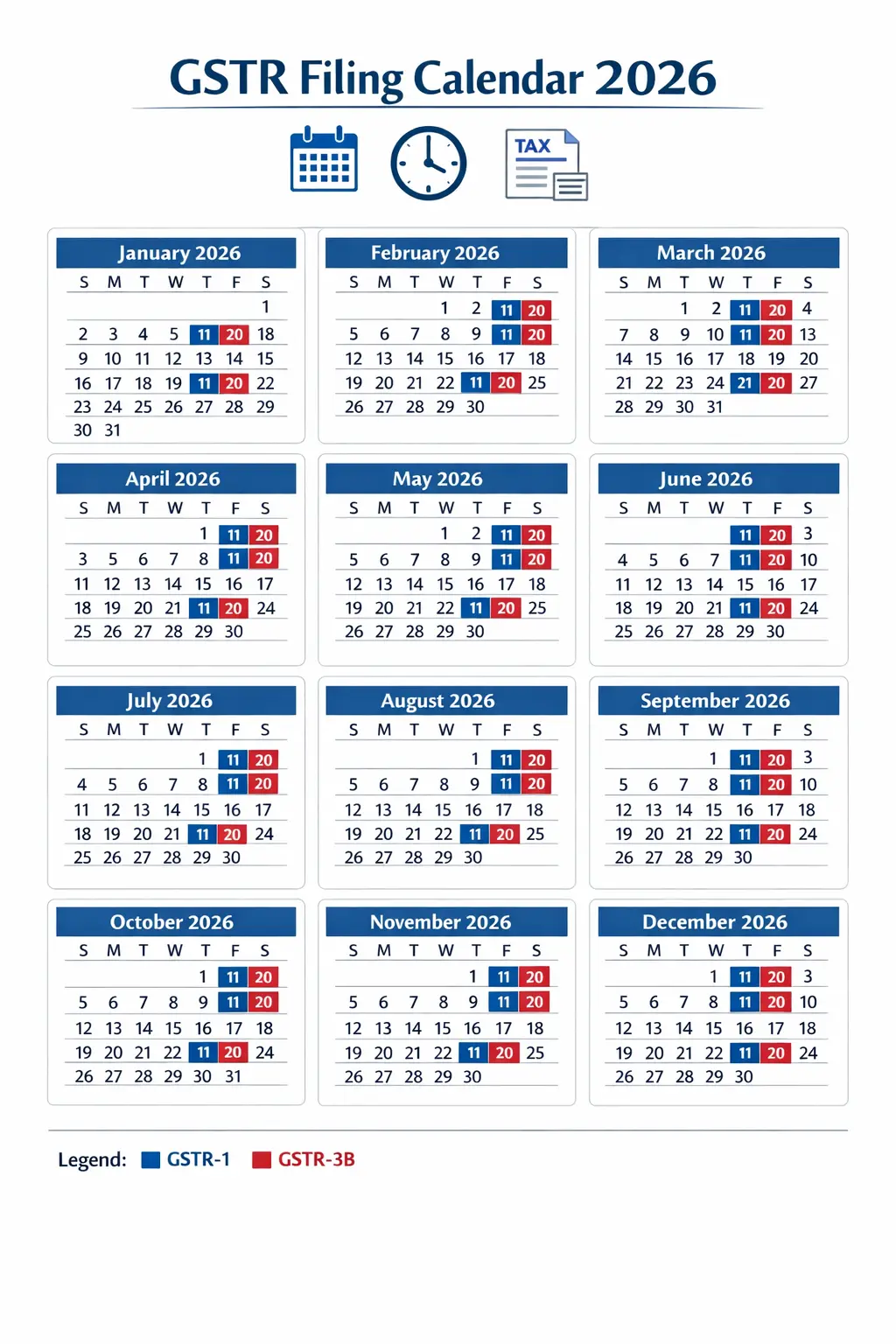
GSTR Filing Deadlines 2026
Missing a GSTR deadline triggers automatic late fees and interest (18% per annum on outstanding tax).
| Return | Due Date |
|---|---|
| GSTR-1 (Monthly) | 11th of following month |
| GSTR-1 (Quarterly - QRMP) | 13th of month after quarter-end |
| GSTR-3B (Monthly) | 20th of following month |
| GSTR-3B (Quarterly - QRMP) | 22nd/24th of month after quarter |
| GSTR-9 (Annual) | 31st December |
| GSTR-9C (Reconciliation) | 31st December |
GST vs VAT vs Sales Tax: Global Comparison
| Tax Type | Structure | Applicability | Transparency | Input Credit |
|---|---|---|---|---|
| GST (India) | Multi-stage unified, CGST/SGST/IGST split | All goods & services except exempted | High — documented at every stage | Yes — full ITC at each stage |
| VAT (UK, EU) | Multi-stage Value Added Tax | Most goods and services | High — tracks value addition | Yes — input tax offset available |
| GST (Australia, NZ, Singapore) | Single unified rate; credits via BAS/return | Most goods & services (some zero-rated) | High — full credit mechanism | Yes — full GST credits via return |
| Sales Tax (USA) | Single-stage, final sale only | Physical goods (varies by state) | Moderate — only final transaction | No — no input credit mechanism |
GST vs HST: India and Canada Compared
GST — India
- Split into CGST, SGST, IGST, UTGST based on supply type
- Administered jointly by Central and State governments
- Rates: 0%, 3%, 5%, 12%, 18%, 28% + cess
- GSTN portal for registration, returns and ITC
HST — Canada
- Combines federal GST (5%) with provincial tax into one rate
- Administered by Canada Revenue Agency (CRA)
- Rates: 13% (Ontario), 15% (Atlantic provinces)
- Quebec uses GST (5%) + QST (9.975%) separately
How This Calculator Works: Practical Examples
Forward GST — Add Tax to Base Price
Base Price: ₹10,000 | Rate: 18% | Intra-State
GST Amount = ₹10,000 × 18 ÷ 100 = ₹1,800
CGST (9%) = ₹900 | SGST (9%) = ₹900
Total Invoice = ₹10,000 + ₹1,800 = ₹11,800
Reverse GST — Extract Tax from Total
Invoice Total: ₹11,800 | Rate: 18% | Need: Base + Tax split
Base = ₹11,800 ÷ (1 + 18÷100) = ₹10,000
GST = ₹11,800 − ₹10,000 = ₹1,800
CGST ₹900 + SGST ₹900 = ₹1,800 total
Frequently Asked Questions
What does GST stand for?
GST stands for Goods and Services Tax — a comprehensive indirect tax levied on the supply of goods and services in India. It replaced indirect taxes like central excise duty, service tax, VAT, CST, and entry tax.
What are the current GST rates in India for 2026?
India has five primary GST slabs in 2026: 0% (essential goods and services), 5% (necessities like food, transport), 12% (standard goods like computers and processed food), 18% (most services and goods), and 28% (luxury and demerit goods like automobiles and tobacco). Special rates of 3% (gold) and 0.25% (diamonds) also apply.
Can I calculate reverse GST — find the base price from a total that includes GST?
Yes. Reverse GST formula: Base Amount = Total ÷ (1 + Rate/100). Example: Total ₹11,800 at 18% → Base = 11,800 ÷ 1.18 = ₹10,000. GST = ₹11,800 − ₹10,000 = ₹1,800. Use the 'Remove GST' toggle in this calculator.
What is the difference between CGST, SGST, and IGST?
CGST and SGST each equal half the applicable GST rate and apply to intra-state (same-state) transactions. IGST equals the full GST rate and applies to inter-state (cross-state) transactions and imports. Example: 18% GST intra-state = CGST 9% + SGST 9%. Same 18% inter-state = IGST 18%.
Does this calculator support VAT, Sales Tax, and HST for countries other than India?
Yes. This calculator supports GST for India, Australia (10%), New Zealand (15%), Singapore (9%), and Malaysia (SST 6-10%); VAT (20%) for the UK; Sales Tax (state-average rates) for the USA; and HST/GST (5–15%) for Canada.
What is the GST registration threshold in India?
GST registration is mandatory when annual turnover exceeds ₹40 lakh for goods suppliers (₹20 lakh for most services). In special category states (NE states, Jammu & Kashmir, Himachal Pradesh, Uttarakhand): ₹20 lakh for goods, ₹10 lakh for services. E-commerce sellers and inter-state suppliers must register regardless of turnover.
About This Calculator — Trust & References
This GST Calculator is developed and maintained by Raviraj Bhosale — web developer specialising in tax calculation tools. Calculation logic is validated against official GST Council guidelines and CBIC arithmetic standards.
GST Framework: GST Council (Official) ↗
Tax Calculation Standards: CBIC — Central Board of Indirect Taxes & Customs ↗
International Rates: ATO (Australia), IRD (New Zealand), IRAS (Singapore), HMRC (UK), CRA (Canada) official rate schedules.
Calculations are based on 2025–26 GST laws and standard tax rates as of March 2026. Always verify with a qualified Chartered Accountant (CA) before financial decisions.
Last reviewed: March 2026 · For estimation purposes only.